



This condom size chart and online quiz helps you find your best condom fit
If you’re not sure what condom size you need, our UK condom size chart explains how to measure your penis, understand nominal width and find a condom that feels comfortable and stays securely in place.
In this article
|
|
TL;DR
• Most men don’t need an XL condom. The right fit depends far more on your girth than your penis length.
• Measure your girth while fully erect. This is the most accurate way to find the correct condom size.
• Check the nominal width. This measurement, shown in millimetres, is more reliable than labels such as Small, Regular or Large.
• A condom that fits properly should roll on easily, stay securely in place and feel comfortable without being painfully tight.
• If you’re between sizes, try a condom trial pack to compare different widths before buying a full box.
Choosing the right condom size isn’t about ego. It’s about finding a condom that feels comfortable, stays in place and provides the protection it is designed to offer.
A condom that is too tight can feel uncomfortable and may be more likely to split. If it is too loose, it can wrinkle, move around or slip off during sex. The wrong fit can also reduce sensation and may be one reason some people find condoms distracting or uncomfortable.
Despite the familiar small, regular, large and extra-large labels, condom sizing is mainly determined by girth rather than penis length. The most useful number to look for is the condom’s nominal width, which is normally shown in millimetres on the box or individual wrapper.
In this guide, we’ll explain how to measure yourself, how nominal width works and how sizes compare across popular UK condom brands. We’ve also previously tried and tested some of the best condoms in the UK if you want help choosing a particular brand or style.
FURTHER READING: Best sex toys for men: Our pick of male sex toys for couples or alone time
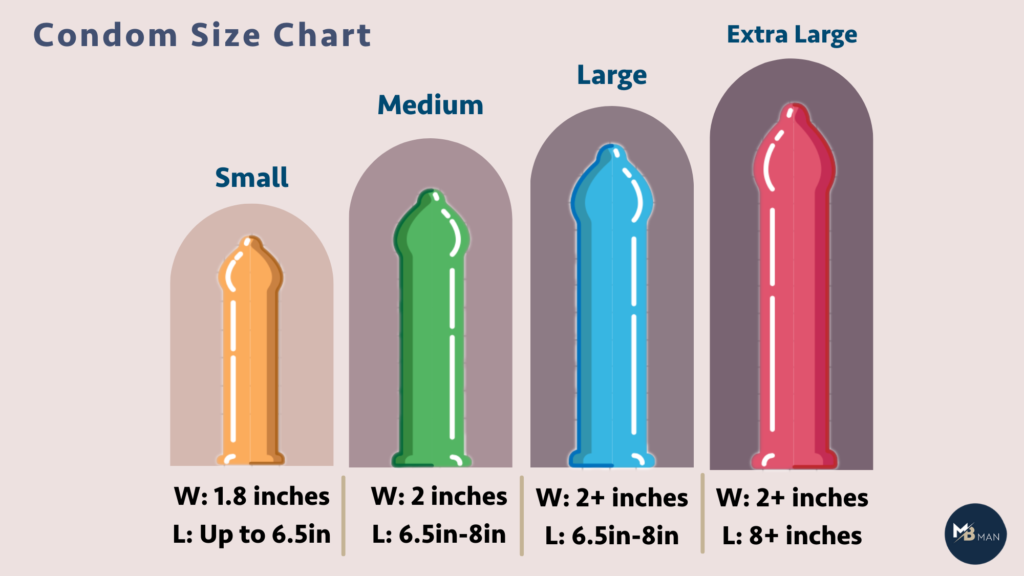
Condom size chart UK
 MBman
MBman
The table below provides a general starting point based on erect penis girth. Measurements and labels differ between brands, so check the nominal width printed on the pack rather than relying only on words such as regular or large.
| Typical condom size | Erect girth | Typical nominal width | What the fit may be called |
|---|---|---|---|
| Small | 9–11.2cm | 45–49mm | Small, snug, trim or close fit |
| Regular | 11.3–12.1cm | 52–54mm | Regular, standard or medium |
| Large | 12.2–13.5cm | 54–60mm | Large, wide or king size |
| Extra large | 13.6–15.5cm | 60–69mm | XL, extra wide or super king |
These figures should be treated as a guide rather than an exact prescription. Condom materials stretch and different products can be straight-sided, tapered or shaped around the head. Two condoms with the same nominal width can therefore feel slightly different.
If you’re close to the boundary between two sizes, try both and choose the one that feels secure without being painfully tight. Trial packs can be useful because they let you compare widths without buying several full boxes.
What is nominal width?
Nominal width is the width of an unrolled condom when it is laid flat. It is measured straight across the condom in millimetres.
It is not the same as the circumference of your penis or the full circumference of the condom. For example, a condom with a nominal width of 54mm is approximately 108mm around when laid flat, before accounting for the material stretching.
Nominal width is more useful than labels such as medium or large because manufacturers don’t all use the same naming system. A condom described as large by one brand may be similar in width to a regular product from another.
When shopping, look for wording such as nominal width, width or, on some Durex packaging, How Wide. If the measurement isn’t obvious on the front of the box, it may be printed on the back or included in the product specifications online.
How to measure your penis for condoms
Measure yourself while fully erect because this is the size the condom needs to fit during sex. A soft measurement won’t give you a reliable condom size.
How to measure penis girth
Use a flexible tape measure and wrap it around the widest part of your erect penis. The tape should sit against the skin without digging in or hanging loose.
The number where the tape meets is your girth, also called circumference. Record it in centimetres or millimetres so that you can compare it with a condom size guide.
If you don’t have a flexible tape measure, wrap a piece of non-stretch string around the widest part, mark where the ends meet and then measure the string against a ruler.
Girth is usually the most important measurement because it determines how securely the condom sits. Sexual health guidance notes that condoms which are too wide or too narrow may be more likely to split or come off.
How to measure penis length
To measure erect length, place a ruler along the top of the penis and measure from the pubic bone to the tip. Press gently through any pubic fat so that the measurement begins at the bone.
Length is worth checking, but it usually matters less than girth when choosing a condom. Most standard condoms are long enough to fit a wide range of penis lengths, and you don’t need to unroll any unused material beyond the base.
A major systematic review involving measurements from more than 15,000 men found that the average erect penis length was 13.12cm, or approximately 5.17 inches. That doesn’t mean everyone needs the same condom size, however, because people with a similar length can have different girths.
Source: BJU International systematic review of penis measurements
What condom size do I need?
Your erect girth gives you a useful starting point, but the final test is how the condom behaves when worn.
A correctly fitted condom should roll down without excessive force, sit smoothly against the penis and remain in place during sex. It should feel secure without causing pain, numbness or an intense squeezing sensation.
If your girth is between 9cm and 11.2cm, start by trying a condom with a nominal width of around 45–49mm.
If your girth is between 11.3cm and 12.1cm, try a nominal width of approximately 52–54mm.
If your girth is between 12.2cm and 13.5cm, a nominal width of around 54–60mm may provide a better fit.
If your girth is between 13.6cm and 15.5cm, look at extra-wide condoms with a nominal width of around 60–69mm.
Don’t worry about which category sounds most flattering. Nobody handing out prizes is inspecting the wrapper afterwards. The right size is simply the one that feels comfortable and remains securely in place.
Signs your condom is too small
A condom may be too small if it is unusually difficult to roll down, feels painfully tight or leaves a pronounced ring around the base of your penis.
You may also notice discomfort, numbness, reduced sensation or difficulty maintaining an erection while wearing it. Although condoms are designed to stretch, that doesn’t mean a very tight fit is the correct one.
Repeated splitting can have several causes, including incorrect application, damage from sharp nails, insufficient lubrication or using an oil-based lubricant with latex. However, a condom that is too narrow can also increase the likelihood of problems.
Try moving up by one nominal-width size rather than jumping immediately from a small condom to the widest available option.
Signs your condom is too big
Shutterstock A condom may be too large if it wrinkles heavily, bunches up, moves during sex or starts rolling back towards the head of the penis.
The clearest sign is that it slips partly or completely off. You should also be able to withdraw after ejaculation while holding the condom securely at the base, without it being left behind.
If your condom repeatedly slips despite being put on correctly, try a narrower nominal width. Adding more lubricant inside the condom can also make slipping more likely, so use only a small drop internally if you want additional sensation and apply the rest to the outside.
UK condom brand size comparison
Brand labels aren’t standardised. This means that a regular condom from one company won’t necessarily have exactly the same dimensions as a regular condom from another.
The measurements below provide examples from popular condom ranges. Always check the current packaging because brands can alter product specifications.
| Brand or range | Fit | Nominal width | What to know |
|---|---|---|---|
| Durex | Close fit | 52.5mm | The narrowest fit in Durex’s main UK sizing guide |
| Durex | Regular fit | 56mm | Wider than many products described as regular by other brands |
| Durex | Wide fit | 57mm | A slightly wider fit; individual Durex products may differ |
| Pasante | Trim | 49mm | A narrower and slightly shorter condom |
| Pasante | Regular | 54mm | The brand’s standard fit |
| Pasante | King Size | 60mm | Wider and longer than its regular condom |
| Pasante | Super King | 69mm | The widest condom in Pasante’s main range |
| MY.SIZE Pro | Size-specific range | 45mm upwards | Uses the nominal width as the product name and offers smaller increments between sizes |
One important detail is that Durex’s regular fit is listed as 56mm, while Pasante’s regular condom is 54mm. That difference may be noticeable if one brand feels comfortable and the other feels loose or tight.
MY.SIZE takes a different approach by naming condoms according to their nominal width. This makes it easier to move up or down gradually rather than relying on broad labels.
 Durex
Durex
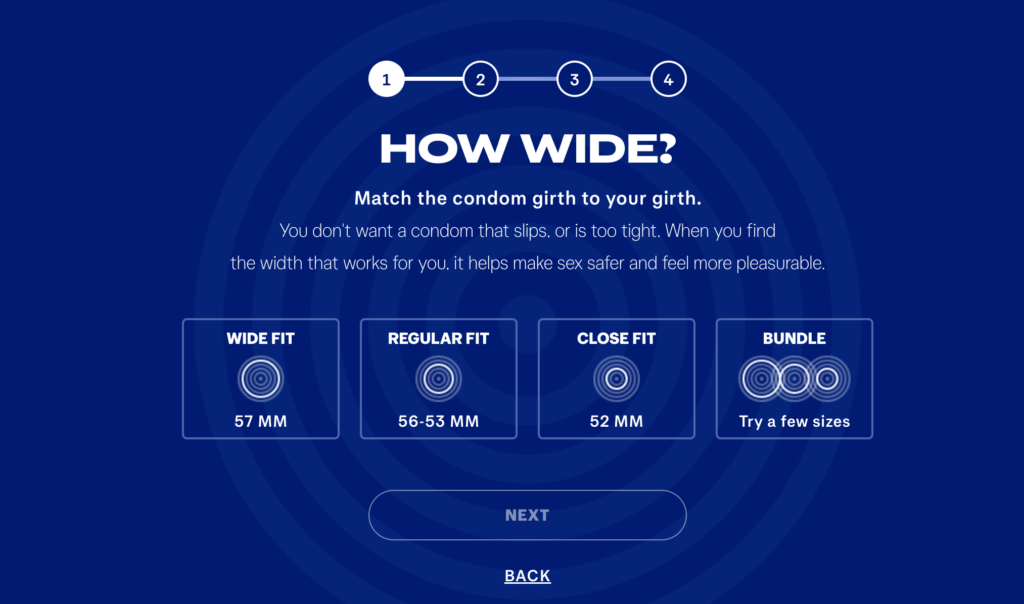
Durex offers an online Find Your Best Fit guide to help narrow down its range. It considers fit alongside preferences such as thickness, lubrication and texture.
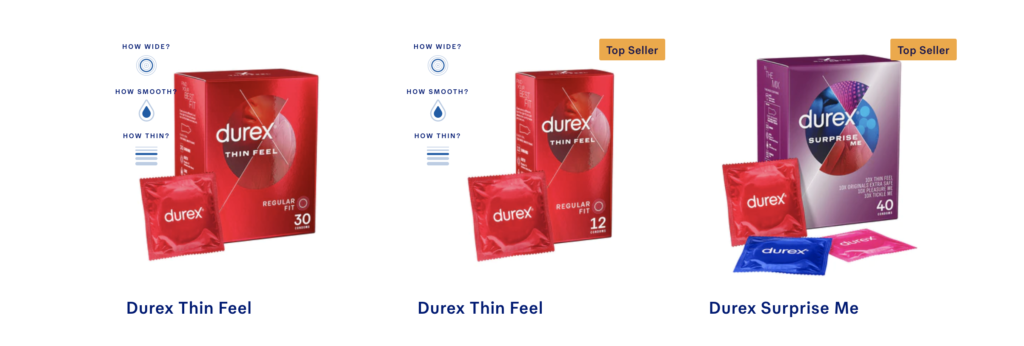
Remember that ribbed, dotted, flavoured and extra-thin condoms aren’t automatically different sizes. These descriptions refer to the condom’s features, not necessarily its width. Check the nominal width of the specific product before buying.
 Durex
Durex
Can you buy condom size trial packs?
If your measurements fall between sizes, or different brands have given you mixed results, a trial pack can be more economical than buying several full boxes.
We recommend looking at the Condom Trial Packs from British Condoms, although other specialist retailers also sell mixed packs and individually wrapped condoms.
When comparing trial condoms, write down the nominal width rather than just the product name. This will make it easier to identify the measurement that works best and find similar products from other manufacturers.
You may also be able to get free condoms through a local sexual health service or C-Card scheme. The brands and sizes offered differ between areas, but some services provide a choice of fits rather than a single standard condom.
Does condom material affect the fit?
Material can change how a condom feels even when the nominal width is the same.
Latex condoms are highly elastic and usually have more stretch. Latex-free condoms made from materials such as polyisoprene may feel softer or behave slightly differently, while polyurethane condoms generally have less stretch.
This means that changing from latex to a latex-free condom may require some experimentation. Don’t assume the same size will feel identical across every material and brand.
If you experience itching, soreness or irritation after using latex condoms, stop using them and try a suitable latex-free alternative. Seek medical advice if symptoms are severe, persistent or accompanied by swelling or breathing difficulties.
FURTHER READING: Best condoms in the UK, including thin and latex-free options
Can lubricant improve condom comfort?
 MBman
MBman
Using enough lubricant can reduce friction and make condoms feel more comfortable. It may also reduce the chance of a condom splitting because of dryness.
Use a water-based or silicone-based lubricant with latex condoms. Don’t use oil-based products such as petroleum jelly, massage oil, body lotion or cooking oil because they can damage latex.
Apply lubricant to the outside of the condom after putting it on. You can add a small drop inside the tip for sensation, but using too much inside may encourage the condom to slip.
Our guide to the best lubricants explains the differences between water-based, silicone-based and oil-based formulas.
What should you do if a condom splits or comes off?
Stop as soon as you notice the condom has split or slipped off. Depending on the type of sex and the risk involved, you or your partner may need emergency contraception, an STI test or advice about HIV post-exposure prophylaxis, known as PEP.
Contact a pharmacist, NHS 111, a GP or a sexual health clinic as soon as possible. Some treatments are time-sensitive, so don’t wait for symptoms to appear before seeking advice.
You should never wear two external condoms at once or combine an external condom with an internal condom. The additional friction can make them more likely to split.
Source: NHS condom guidance
Condom size FAQs
Are condoms one size fits all?
No. Condoms stretch, but they are made in different widths, lengths and shapes. A standard condom will fit many people, but it won’t provide the best fit for everyone.
Is condom girth or length more important?
Girth is generally more important because it determines whether the condom grips securely. Most condoms are long enough for a wide range of penis lengths, whereas the wrong width can make one feel painfully tight or cause it to slip.
What is the average condom size in the UK?
There is no single standard measurement used by every brand. Condoms described as regular commonly have nominal widths of roughly 52–56mm, but you should check the measurement on the particular product.
How do I know whether I need small condoms?
Consider a smaller or close-fit condom if regular condoms wrinkle excessively, move during sex or repeatedly slip off despite being put on correctly. Small condoms commonly have a nominal width of around 45–49mm, although Durex describes its 52.5mm option as close fit.
How do I know whether I need large condoms?
Try a wider condom if regular products feel painfully restrictive, are difficult to roll down or leave a deep pressure mark. Large condoms commonly range from approximately 54mm to 60mm in nominal width, while extra-wide products can reach 69mm.
Are all Durex condoms the same size?
No. Durex sells close, regular and wide-fit condoms, and the dimensions can differ between individual product ranges. Check the width listed on the box or product page rather than assuming every Durex condom will fit in the same way.
Do extra-thin condoms fit differently?
Not necessarily. Extra-thin describes the thickness of the material, not the width. An extra-thin condom may use the same nominal width as a standard or thicker condom from the same range.
Can a condom be too tight?
Yes. A condom should feel secure, but it shouldn’t be painful, cause numbness or feel as though it is cutting into the penis. If it does, try the next nominal width up.
Why does my condom keep slipping off?
The condom may be too wide, may not have been rolled down fully or may contain too much lubricant on the inside. Losing an erection before withdrawal can also cause slipping, which is why you should hold the condom at its base while withdrawing.
Can I stretch a small condom to make it fit?
Condoms are designed to stretch, but forcing yourself into one that feels painfully tight isn’t a sensible substitute for buying the right size. Choose a wider nominal width instead.
Should I measure when erect or soft?
Measure when fully erect. Flaccid penis size varies considerably and doesn’t reliably show which condom width you need during sex.
Does a larger penis always need an extra-large condom?
Not necessarily. Length and girth don’t always increase together. Someone with a long but relatively slim penis may still get a better fit from a regular-width condom, while someone shorter but wider may need a large size.
Does condom size affect pleasure?
It can. A painfully tight condom may reduce comfort or sensation, while a loose condom can move around and become distracting. Finding the correct width may make a bigger difference than simply choosing the thinnest product available.
Where is the condom size shown on the packet?
Look for a measurement in millimetres labelled nominal width, width or How Wide. It may be printed on the back or side of the box rather than beside the small, regular or large description.
Condom size: the bottom line
The best condom size is the one that stays securely in place without feeling painfully tight. Measure your erect girth, use nominal width as your starting point and don’t rely too heavily on vague size labels.
If regular condoms slip, move down in width. If they feel uncomfortable or difficult to roll down, try a wider size. When you’re between measurements, a condom trial pack is the simplest way to compare fits.
Above all, don’t choose a size because of what it says on the packet. A correctly fitted small condom is considerably more useful than an XL one disappearing at an inconvenient moment.
MORE LIKE THIS

Best advent calendar for men 2026: Our pick of the best men’s grooming and skincare calendars
Best men’s skincare for oily skin and how to build an oily skin routine
This condom size chart and online quiz helps you find your best condom fit
Sex toys for men UK: Our pick of the best cheap and luxury male sex toys

Dandruff: What is it, what causes it and how to get rid of dandruff for good

Beau Domaine: Brad Pitt skincare range expands to creams, a cleanser and more

How to prevent hair loss in men

Men’s skincare routine: Which men’s grooming products do you *actually* need?

What causes acne in men and how to get rid of it on your face, neck and back

Best skincare for men: How to actually look after your face with our simple tips